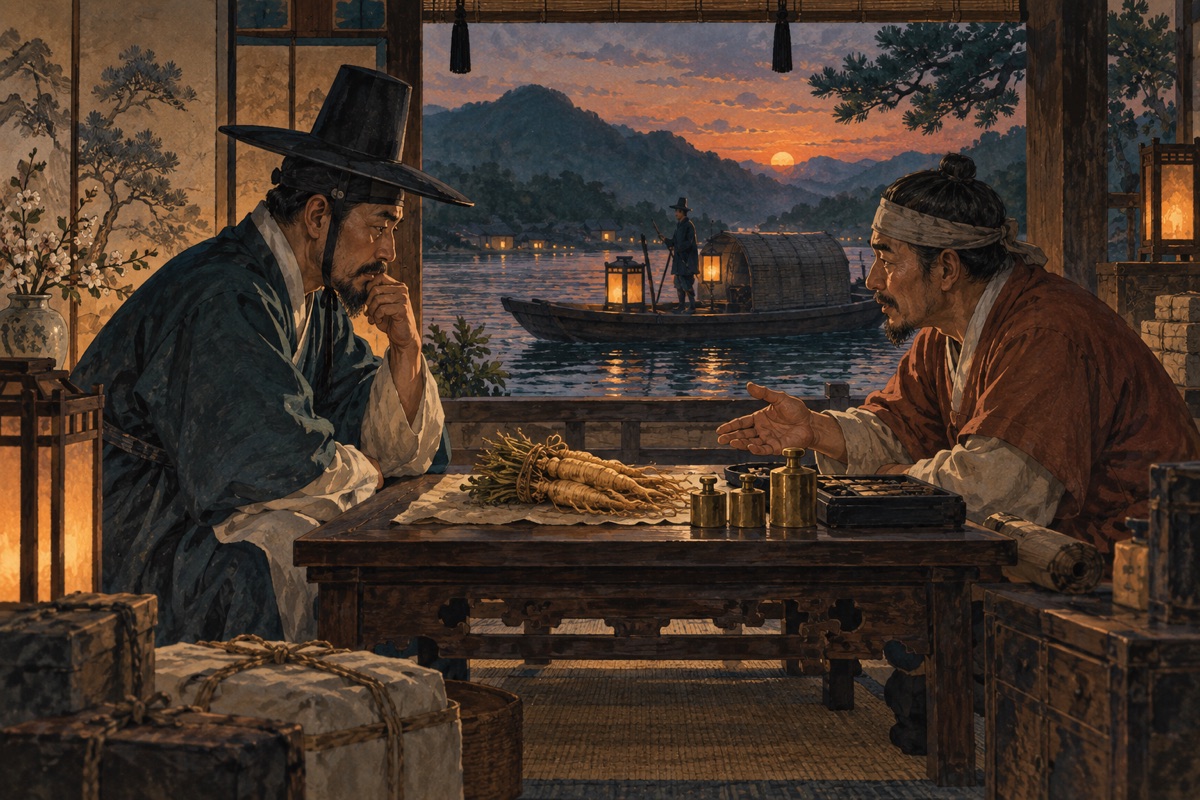
In the book
The novel sets Im’s higher ginseng price against a coordinated refusal to buy. His stock and the buyers’ need for it matter, but so does the approaching return journey. The famous burning episode gives the confrontation dramatic force. It should not be treated as a recipe for destroying inventory or as independently verified market history. Its useful question is what makes a threat credible—and who bears the loss if the other side does not yield.
Analysis
Separate your preferred price from your ability to wait. Suppose a hypothetical merchant holds 100 units costing 20 each. A price of 30 creates a gross margin of 1,000 only if everything sells; three weeks of storage at 100 per week reduce that to 700 before other costs. Unsold goods still tie up cash. Before threatening to walk away, identify another buyer, the cost of delay and the last date on which you can change course. A dramatic victory in a story cannot tell you the probability of success in your own negotiation.
- A deadline changes bargaining power.
- An alternative must be usable, not merely imaginable.
LEGO • limits before expansion
Source-grounded facts
LEGO’s 2004 annual report records a loss and an action plan to restore value creation. It documents a business confronting the limits of its existing direction.
Case analysis
Use this as a starting point for a hypothetical expansion review. A toy workshop adds five product lines. Each appears attractive in isolation, but together they need more parts, storage and management attention. A profitable-looking sale can arrive after the cash needed to build it has already left. Ask the team to draw the sequence from payment to production to collection. Then test what happens if customers pay a month late. For the negotiation lesson, this reveals the cost of waiting. For the cup lesson, it reveals why unused capacity can matter. Neither exercise proves what caused LEGO’s results; the comparison helps formulate better questions about commitments.
For this lesson, use the LEGO comparison to examine the cost of waiting rather than to copy a turnaround formula. Imagine a small workshop negotiating a larger order. It must pay 60 units for materials immediately and another 20 for wages before receiving 100 from the customer. On paper, the order leaves 20 before other costs. But a workshop starting with only 70 units of cash cannot reach the payment date without another source of cash or a change in terms. Profit on the order and the ability to complete it are different questions.
Now compare three responses: request a deposit, stage deliveries and payments, or decline the order. Each changes the negotiation. A deposit shifts some funding burden to the customer; staging may reduce the workshop’s peak commitment; declining preserves resources but gives up potential profit. None is automatically best. Mark the dates at which cash leaves and enters, then ask what happens if payment is delayed. Im’s ability to hold firm becomes a modern question about alternatives and endurance: can you support your position long enough without making promises you cannot keep?
Case exercise
Why might a profitable order weaken a seller’s negotiating position?
Analysis guide
Costs may fall due before receipts. If the seller cannot finance the gap, urgency can force worse terms. A deposit or staged payment can change that timing risk.
Limits of the comparison
A report from one period cannot by itself establish the causes of failure or the success of a later recovery.
Reflection
What would make you change your mind before your resources run out?